
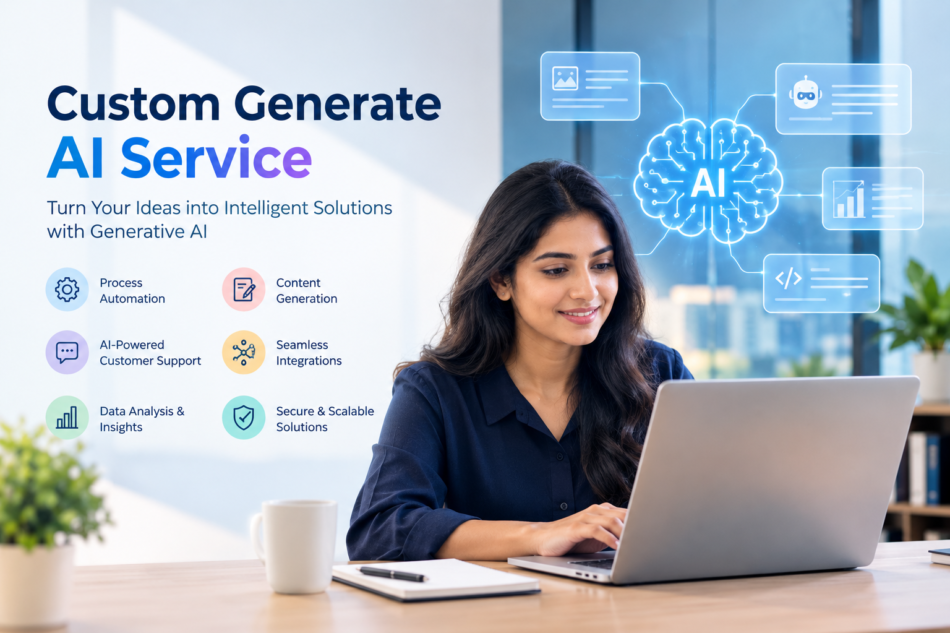

Custom Generate AI Service
A SEO Custom Generate AI Service can help modern businesses bring artificial intelligence into their everyday operations in a practical and meaningful way. Artificial intelligence is no longer limited to research laboratories or experimental projects. Businesses are increasingly exploring AI to automate repetitive work, improve customer interactions, analyze information, support employees, and create more efficient workflows. A custom approach allows organizations to develop AI capabilities around their own data, processes, industry requirements, and business goals instead of depending only on generic tools.
Understanding Custom Generative AI
Generative AI has changed the way businesses think about automation and digital transformation. Traditional software usually follows predefined instructions, while generative AI can work with information, understand context, create content, and support more flexible interactions.
Naveera Technology describes generative AI services as solutions that can reason across enterprise data, generate domain-specific outputs, and automate complex knowledge workflows. The company also focuses on production-ready AI systems with governance, human oversight, security, scalability, and measurable business objectives.
A custom generative AI service goes a step further by adapting AI capabilities to the particular requirements of an organization. Every company has different data, employees, customers, workflows, software systems, and challenges. A solution designed around those factors can be more relevant than a general-purpose application.
Why Businesses Are Exploring Generative AI
Businesses manage large amounts of information every day. Employees may spend considerable time searching through documents, preparing reports, responding to repetitive questions, reviewing data, creating content, or moving information between different systems.
AI can support these activities by helping people access and process information more efficiently. Instead of replacing every existing business process, organizations can use AI as an additional layer that supports employees and improves the way information is handled.
Naveera highlights several enterprise applications for generative AI, including intelligent workflows, customer experience, virtual assistants, data analysis, decision intelligence, content generation, and automation.
The most useful application depends on the organization. Some businesses may begin with customer support, while others may focus on internal knowledge management, reporting, or workflow automation.
Custom AI for Business Workflows
Every organization develops its own way of completing tasks. Employees follow processes for approving documents, managing customer information, preparing reports, handling requests, and communicating with different departments.
When AI is connected to these workflows, it can assist with repetitive or information-heavy activities. Naveera describes intelligent workflows that can automate complex multi-step processes while keeping human oversight within automated operations.
For example, an organization may have employees who regularly collect information from different sources before preparing a report. A custom AI solution could help gather relevant information, organize it, summarize it, and present it to the employee for review.
The final decision can remain with the human employee while AI reduces some of the manual effort involved in preparing the information.
AI-Powered Customer Experiences
Customer expectations have changed as digital communication has become a normal part of everyday life. People often want quick responses and easy access to information.
AI-powered virtual assistants can help businesses respond to common customer requests, provide information, and support conversations across digital channels. Naveera’s generative AI services include enterprise AI assistants designed for contextual and personalized customer interactions, with integration into CRM and digital engagement platforms.
A custom AI assistant can be designed around a company’s products, services, communication style, and approved information sources. This can make interactions more relevant while allowing human support teams to focus on situations that require personal attention.
Human involvement remains important, especially when customers have complex or sensitive requirements. AI can support the conversation without necessarily becoming the only point of contact.
AI for Data Analysis
Businesses collect information from many sources, including customer systems, sales platforms, operational software, financial applications, and business intelligence tools.
Understanding this information can sometimes require significant time and technical knowledge. Generative AI can provide another way for employees to interact with business information.
Naveera describes generative AI solutions that allow natural-language interaction with enterprise data, automated executive summaries, contextual insights, and connections with analytics and business intelligence platforms.
Instead of relying only on complex queries, employees may be able to ask questions using natural language and receive information in a more understandable format. The usefulness of such a system depends on data quality, access controls, integration, and appropriate validation.
The Importance of Customization
One of the biggest advantages of custom AI development is the ability to design a solution around a company’s actual environment.
A generic AI application may work well for general tasks, but organizations often have specialized requirements. They may use industry-specific terminology, internal documents, proprietary information, legacy applications, or unique workflows.
Naveera states that its custom AI solutions are aligned with enterprise proprietary data, operational workflows, industry requirements, and complex business environments. Its development approach includes LLM-based applications, domain-specific models, agentic AI patterns, retrieval-augmented solutions, multimodal models, and AI-powered automation.
This type of customization can help organizations create AI applications that are more closely connected to their existing operations.
Connecting AI With Existing Systems
AI becomes more useful when it can work with the systems that employees already use.
Businesses may have ERP platforms, CRM systems, databases, APIs, business intelligence applications, and other software. Creating an isolated AI application may limit its usefulness if employees still need to move information manually between systems.
Naveera describes integration with APIs, microservices, core data platforms, ERP, CRM, and BI systems, as well as support for legacy, modern, multi-cloud, and hybrid environments.
Integration allows AI capabilities to become part of existing workflows rather than operating separately.
For example, a customer service assistant could access approved information from a CRM system, while an internal reporting assistant could connect with selected business data. Access should always be controlled according to the organization’s security requirements.
Security and Responsible AI
Security is an important consideration when businesses introduce AI into their operations. AI systems may interact with confidential business information, customer data, internal documents, or proprietary knowledge.
A responsible implementation should consider who can access information, how data is stored, how systems communicate, and how AI outputs are monitored.
Naveera describes security measures including encryption, role-based access control, secure API architecture, model validation, output filtering, audit logging, and data protection. Its page also references alignment with frameworks and regulations such as SOC 2, HIPAA, GDPR, and CCPA where applicable.
Security requirements can vary depending on the industry and type of information involved. Businesses should therefore evaluate their specific compliance obligations before deploying AI systems.
Human Oversight in AI
AI can produce useful results, but human oversight remains an important part of responsible implementation.
Employees may need to review generated information, approve decisions, verify sensitive outputs, or handle situations where AI cannot provide an appropriate response.
Naveera specifically emphasizes human oversight and governance as part of its approach to enterprise generative AI.
This approach recognizes that technology and human expertise can work together. AI can handle certain information-heavy tasks while people continue to provide judgment, context, accountability, and decision-making.
LLMOps and Continuous Improvement
Launching an AI application is not necessarily the end of the development process. AI systems may need monitoring, performance evaluation, updates, and refinement as business requirements change.
Naveera describes LLMOps and MLOps practices involving model monitoring, performance tracking, output optimization, usage governance, version control, and retraining workflows.
Continuous improvement can help organizations identify areas where an AI system performs well and areas where additional refinement may be required.
Business data, customer expectations, regulations, and internal processes can change over time. An AI solution should therefore have a structure that allows it to evolve.
Generative AI Across Different Industries
Generative AI can be adapted to many industries because businesses in different sectors have different information and workflow requirements.
Naveera lists healthcare and life sciences, banking and financial services, retail and consumer technology, and manufacturing and industrial AI among the industries it serves. Its examples include clinical documentation, research summarization, customer engagement, compliance automation, personalization, supply chain support, production planning, and operational analytics.
The technology can therefore be applied in different ways depending on the industry.
A healthcare organization may focus on documentation and information management, while a retailer may focus more heavily on customer engagement and personalization. A manufacturing company may explore AI for operational information and planning.
Moving From AI Ideas to Real Applications
Many businesses are interested in artificial intelligence but may not know where to begin.
Starting with every possible AI application at once can make implementation complicated. A more structured approach can involve identifying business challenges, evaluating available data, understanding technical requirements, defining measurable goals, and selecting suitable use cases.
Naveera’s consulting approach includes use-case discovery, data readiness assessment, architecture evaluation, KPI and ROI frameworks, phased roadmaps, risk management, and compliance considerations.
This type of planning can help organizations understand how AI fits into their broader business strategy.
Cloud and Hybrid AI Environments
Modern organizations may operate across cloud platforms, private infrastructure, and older systems. AI solutions therefore need to work within the technical environment of the business.
Naveera describes cloud-based generative AI platforms, private and hybrid models, enterprise data integration, controlled access management, and encryption protocols.
A suitable infrastructure can help organizations manage AI applications while considering security, scalability, performance, and operational requirements.
The right technical architecture depends on the business, its data, existing systems, and the type of AI application being developed.
Generative AI as an Ongoing Service
Some organizations may prefer to manage AI internally, while others may require external support for development, monitoring, integration, and improvement.
Naveera offers different engagement models, including consulting engagements, end-to-end development projects, dedicated generative AI teams, and managed generative AI services.
Managed services can be useful for businesses that need continued support after deployment. Ongoing monitoring and refinement can help keep an AI solution aligned with changing business requirements.
Building AI With a Practical Approach
Successful AI adoption is not simply about using the newest technology. It is about finding practical ways to solve real business problems.
A company may have access to advanced AI models but still struggle to create value if its data is poorly organized, its systems cannot communicate, or employees do not understand how to use the technology.
A custom AI project should therefore consider technology, people, processes, security, data, and business objectives together.
The best starting point may be a specific workflow where employees spend significant time on repetitive information-related activities. Once the value of AI is understood in that area, the organization can consider expanding its use.
The Future of Custom Generative AI
Generative AI is continuing to become part of business technology. As organizations gain more experience with AI, the focus is moving beyond experimentation toward practical implementation, integration, governance, and measurable outcomes.
Custom AI solutions can play an important role in this transition because they allow businesses to connect AI capabilities with their own information and workflows.
Naveera’s published approach focuses on moving generative AI from pilots into live enterprise environments through production engineering, governance, security, integration, monitoring, and continuous improvement.
This reflects a broader shift toward treating AI as an ongoing business capability rather than simply a standalone tool.
Conclusion
A Custom Generate AI Service can give businesses an opportunity to use artificial intelligence in ways that are closely connected to their individual requirements. From intelligent workflows and virtual assistants to data analysis, content generation, automation, and decision support, custom AI can become part of many areas of an organization.
The value of custom generative AI comes from more than the AI model itself. Successful implementation also depends on good data, secure architecture, thoughtful integration, responsible governance, human oversight, and continuous monitoring.
Naveera Technology’s generative AI services focus on these areas, with solutions designed around enterprise data, workflows, industry requirements, integrations, security, governance, and long-term operational needs.
For businesses considering AI adoption, the journey can begin with understanding a real problem and identifying where intelligent technology can provide useful support. From there, a suitable solution can be designed, tested, integrated, monitored, and improved over time.
Generative AI is becoming an important part of modern digital transformation, but its real value comes from how thoughtfully it is applied. When technology is combined with human expertise and a clear understanding of business needs, custom AI solutions can become a practical part of everyday operations and future growth.
